Industrial buildings without context create friction.
A data center or warehouse that looks like it was dropped from orbit generates opposition, stalls planning approval, and strains community relationships. Prismaclad changes that with a treatment built around where the building actually is.
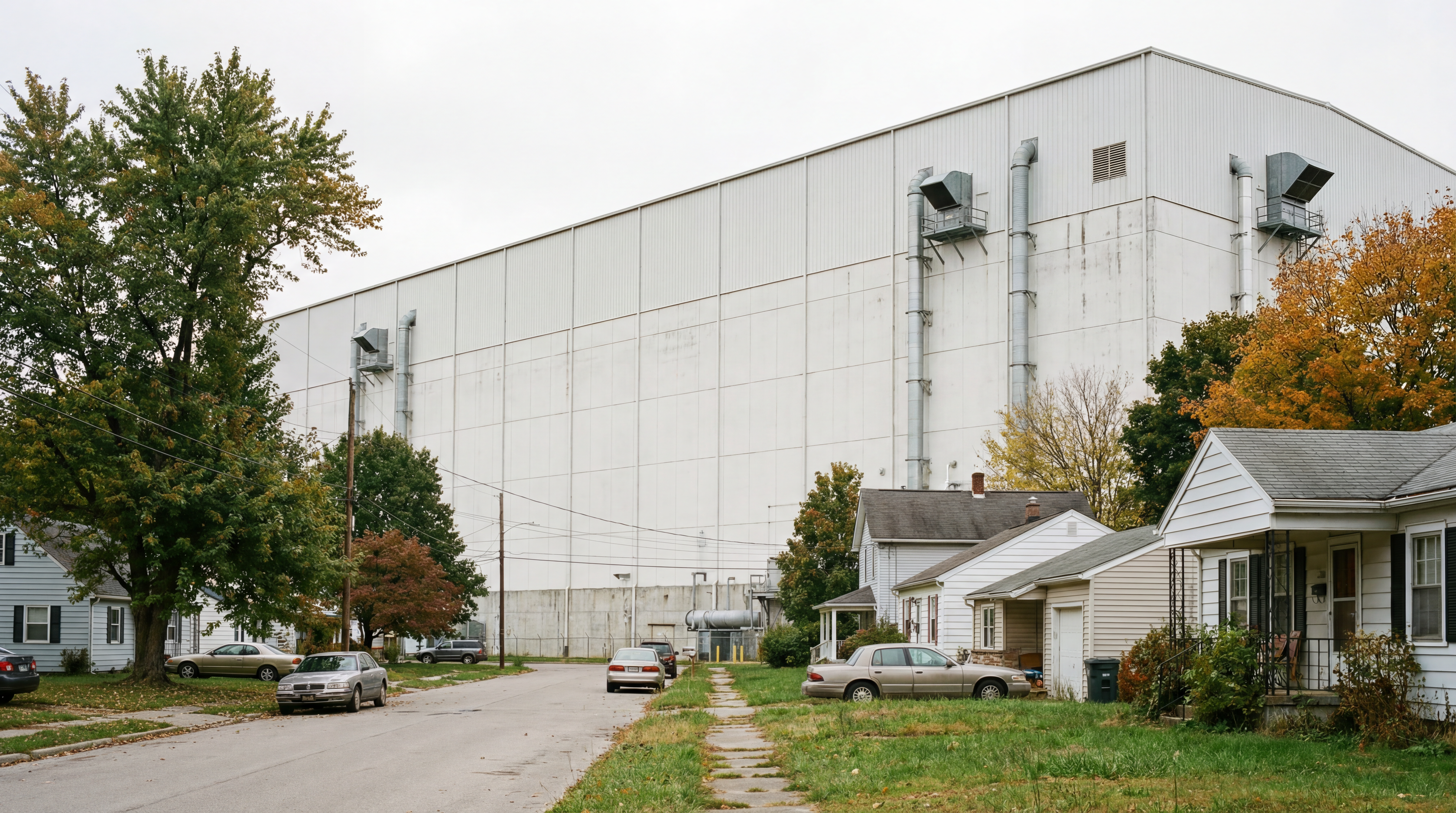
The build pace has outrun the goodwill.
In five years, data center construction went from a specialized sector to a ubiquitous one. Bigger facilities, more sites, landing in more jurisdictions — including ones that have never had a windowless concrete building a block from a residential street. AI demand accelerated that pace further still, and it isn't slowing.
These buildings draw opposition because of scale and context, not because people dislike progress.

The Scale Gap
A hyperscale wall runs 50–60 feet tall with no windows, no articulation, no visual break. Screening trees top out at 35 feet on a good site. The math doesn't work, and communities can see it.

The Context Gap
Data centers land in industrial zones that share property lines with residential streets. The zoning classification permits the building; it says nothing about how it has to look from the sidewalk across the road.

No Aesthetic Review
Commercial buildings go through design review. Industrial construction typically doesn't. That gap means the first time the community sees the project, it's already breaking ground — which is when the opposition starts.
Why aesthetics became a permitting risk
Zoning codes rarely said anything about how industrial buildings had to look until communities started pushing back. Loudoun County, Fairfax County, Prince William County — all wrote facade requirements into their data center ordinances after residents objected to what was going up on the land next to them.
What killed $64 billion in U.S. data center projects was not cost overruns or permitting delays in the conventional sense. It was visual friction — buildings that looked wrong for the context they landed in, and communities that had the political leverage to say so.
Prismaclad exists at that intersection. A data center wall can be treated. The treatment can satisfy the ordinance language, change how the building reads from the street, and do it at a cost that is a rounding error on the total project budget.
What creates opposition:
- Blank walls visible from residential streets
- Industrial scale incompatible with neighborhood context
- No visual mitigation in permit applications
- Zoning language the project can't demonstrably satisfy
What Prismaclad addresses:
- Reduce community opposition and planning friction
- Strengthen how a development is received
- Transform an industrial intrusion into something considered
- Work across new construction and existing structures
The photo in the story follows you to the next town.
Named operators and hyperscalers carry public-image stakes that extend well beyond a single permit. One bad site becomes the reference point in every subsequent community conversation — and in investor ESG reviews.
The photo in the story
That blank wall next to the subdivision becomes the lead image in local news coverage. It doesn't matter what the building is doing inside.
Portfolio-level liability
A bad-faith reputation from one site makes the next entitlement hearing harder before you've said a word. Communities talk to each other.
Investor scrutiny
The S in ESG is increasingly watched. Community impact from large industrial deployments is a measurable social metric, not a soft concern.
Future approvals
Jurisdictions share notes. An operator with a track record of blank walls gets more scrutiny in the next county's public hearing.
Ignoring it is the expensive decision.
A facade treatment runs between 0.1% and 0.5% of total build cost on a hyperscale facility. That is not a rounding error — it is a rounding error's rounding error. The cost of not doing it is not that tidy.
A stalled project carries months of financing cost, consultant fees, and schedule compression on the back end. A killed project carries all of that plus the sunk cost of land, permits, and pre-construction work. A damaged reputation carries a surcharge on every subsequent entitlement, measured in time, legal fees, and goodwill concessions that are much harder to price.
The fix is not cheap because it is trivial. It is cheap relative to what it prevents.
The cost of the problem:
- Months of delay carrying full financing cost
- Dead projects: sunk land, permits, pre-construction
- Concessions forced under community pressure (setbacks, size reductions, benefit packages)
- Headline exposure that follows the operator to the next site
- Higher scrutiny in every subsequent county
The cost of the fix:
- 0.1%–0.5% of total build cost
- No changes to the building envelope
- No permit restarts
- Satisfies facade-treatment and aesthetic-compliance ordinance language
- Reusable design system across a multi-site portfolio