The Data Center Facade Ordinance Tracker: What Counties Actually Require
Counties are writing 'facade treatment' into their data center codes faster than anyone can keep up with. Here is the actual language, county by county, and what each requirement means if you're the one trying to get a building approved.
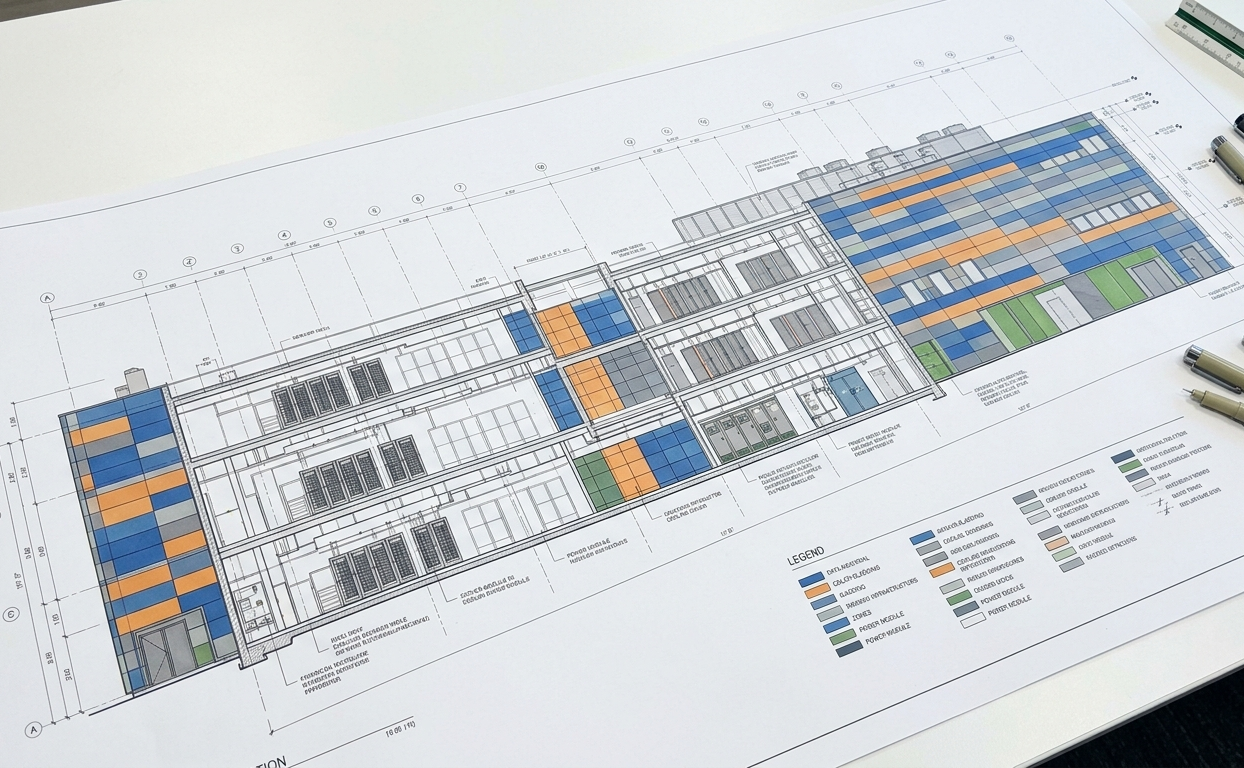
Every few months another county adds language to its zoning code requiring data centers to look like something other than a blank box. Almost none of them use the same words. Some require "facade treatments," some require "fenestration," some require "articulation," and at least two now say the requirement can be met with a mural.
This page tracks the actual language, jurisdiction by jurisdiction. If you're entitling a data center in one of these markets, the exact wording matters more than any summary of it, because the wording is what a planning board holds you to. We'll keep it current as new ordinances pass. They are passing fast.
A note on the map. Virginia dominates the list because Virginia has the most data centers and no statewide rule, so its counties write their own standards and everyone else reads them. But the same language has already spread to Georgia and Arizona, and the pattern is the same wherever it lands.
Loudoun County, Virginia
The 2023 Zoning Ordinance rewrite introduced the phrase that everyone else copied: principal facade building treatments. Data centers have to provide them on every side adjacent to residential property, and Loudoun defined "residential" broadly enough to include stand-alone religious assemblies, parks, farm wineries, and breweries. The ordinance never says what a treatment actually is. It stacks the aesthetic requirement on top of building setbacks, six-foot berms, enhanced buffers, screened rooftop equipment, and pre- and post-construction noise studies.
In 2025 Loudoun went further and eliminated by-right data center development entirely. That change matters for the facade question, because it pushes more projects into legislative review, where the design gets negotiated in public rather than checked against a standard. Loudoun is the largest data center market in the world, so its wording tends to become the starting draft for the next county over.
Prince William County, Virginia
Prince William's Data Center Opportunity Zone Overlay District requires that principal building facades avoid the use of undifferentiated surfaces. Where Loudoun is vague, this one is close to a checklist: a principal facade has to include at least two design elements from a list covering changes in height, changes in building material, or window and door design. A principal facade is any face fronting a major arterial or interstate, and when a building has more than one, they all have to stay consistent in design, materials, and treatment.
This is the ordinance most likely to reward a surface treatment on its own terms. A pattern that shifts material read and window rhythm across the wall can satisfy two of the required elements at once, on every principal face, without touching the envelope.
Fairfax County, Virginia
Adopted September 2024. Fairfax requires a main entrance feature, a variation in the facade surface every 150 feet, and a minimum amount of fenestration. Then it says the part that matters most in this whole conversation: the fenestration can include faux windows.
That is the clearest signal in any code that a surface solution is acceptable. The county is telling you, in the text, that a window does not have to be a window. For rezonings and special exceptions, Fairfax also requires architectural renderings and sight-line studies, so you have to show the reviewing body what the building looks like from the road before you get an approval. What you put on the wall is now part of the application, not an afterthought to it.
Henrico County, Virginia
Passed June 2025, after being tabled once amid the usual public fight. Henrico leans on distance and screening more than on the wall itself: 500 feet of separation from residential, substation screening, vegetative buffers, and setbacks, organized inside a new Technology Boulevard Special Focus Area overlay around the White Oak Technology Park. The building-design guidance is there but softer than Fairfax's.
It's worth watching anyway, because a large share of the next wave of Richmond-area capacity is headed here, and softer language tends to harden once the first few projects come through and the neighbors show up.
DeKalb County, Georgia
DeKalb wrote what its own staff called a first-of-its-kind ordinance, sorting data centers into categories by square footage and power draw. The facade rule has a number attached: within 300 feet of a public road, at least 30 percent of the width of the front facade at ground level has to be fenestration.
Here is the line that matters. Murals and other decorative treatments count toward that fenestration requirement, up to 10 percent of the front facade. Georgia has passed something like half a dozen of these ordinances since September 2024, and DeKalb is the one that put an actual percentage on how much of the wall is allowed to be art.
City of Phoenix, Arizona
Adopted July 2025. Phoenix requires screening by either an integrated building or a decorative wall carrying varied colors, materials, patterns, textures, or art, set 150 feet from rights-of-way and residential zoning, alongside a 30-foot landscape setback with two staggered rows of canopy trees. On the building, any facade longer than 100 feet needs embellishments like recesses, pilasters, or fenestration, and every side has to vary its materials, colors, patterns, textures, height, or art.
Phoenix is notable for writing "art" directly into the list of acceptable treatments, in more than one place, as a peer of material and texture rather than a nice-to-have.
| Jurisdiction | Adopted | Operative language | Art / mural named? |
|---|---|---|---|
| Loudoun VA | 2023 | principal facade building treatments | No |
| Prince William VA | Ongoing | avoid undifferentiated surfaces | No |
| Fairfax VA | Sep 2024 | Variation every 150 ft; fenestration can include faux windows | Faux windows — yes |
| Henrico VA | Jun 2025 | 500-ft separation + screening (overlay) | No |
| DeKalb GA | 2025 | 30% front-facade fenestration; murals count up to 10% | Murals — yes |
| Phoenix AZ | Jul 2025 | varied colors, materials, patterns, textures, or art | Art — yes (twice) |
The pattern underneath all six
Read them side by side and the same structure shows up every time. None of these codes require a specific method. They require an outcome, a wall that doesn't read as blank, and then hand the applicant a menu. The menu almost always includes some mix of material change, fenestration, articulation, and, more and more often, art or murals named outright.
That naming is the real shift. Two years ago the aesthetic conversation happened off the record, as a condition a supervisor asked for during approval. Now it's written into the ordinance with numbers attached: 30 percent fenestration, variation every 150 feet, treatment on every side adjacent to residential. The requirement moved from favor to code.
And the code is converging on language a surface treatment answers directly. Fairfax says a window can be faux. DeKalb says a mural counts. Phoenix lists art next to materials and texture. These aren't loopholes. They're the jurisdiction telling you, in the text of the law, that the surface of the wall is where the requirement gets satisfied.
What to check before you file
Summaries drift, and the wording in your jurisdiction is the wording that binds you. Before an application goes in, pull the actual ordinance section and read for three things. Which sides of the building the treatment applies to, since "adjacent to residential" and "fronting a major road" cover very different amounts of wall. Whether the requirement is written as a number or a judgment call, because 30 percent fenestration is a target you can hit on paper and "high-quality design" is an argument you have to win. And whether the code names art, murals, or faux fenestration as acceptable, because that single sentence decides whether a surface treatment clears the bar outright or has to be defended.
If you're working in a county that isn't on this list yet, it probably will be. The language is portable, the market is spreading, and the counties writing new rules are reading the ones already on the books.