Data Centers Are Ugly. That's Now a Zoning Problem
Counties from Loudoun to New Albany now require data centers to be 'attractive' — without defining what that means. Between decades-slow landscaping and full architectural redesign sits a gap. That gap is where the real problem, and the real solution, live.
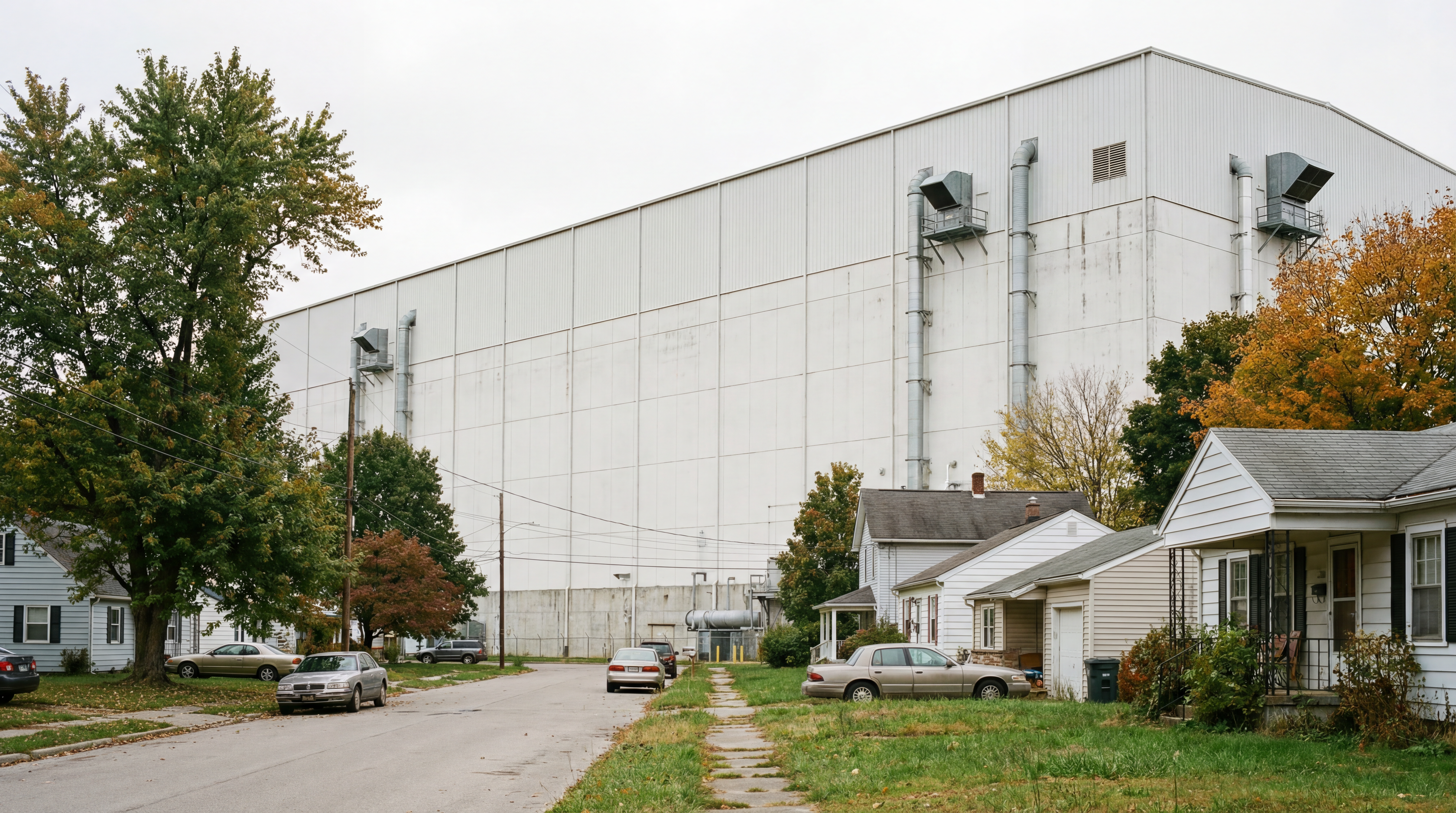
Counties across the country now require data centers to be "attractive." None of them say how.
That ambiguity matters more than it might seem. Roughly $64 billion in U.S. data center projects have been stalled or killed by community opposition. Jurisdictions from Loudoun County to New Albany are rewriting their codes faster than developers can respond. And the industry's default answer to the visual problem—planting trees and pushing dirt—is a geometric mismatch with concrete boxes rising 60 to 99 feet, the size of four football fields.
The result is a two-tier market. At the cheap end: landscaping that takes decades to mature, dies at measurable rates, and rarely reaches the top of the wall. At the expensive end: full architectural redesign, reserved for the handful of sites where the politics demand it. In between, almost nothing.
That middle is where the problem actually lives.
What the codes say
The operative phrase in 2026 is "principal façade building treatments." Loudoun County required them in its December 2023 zoning rewrite, on all sides adjacent to residential property, without defining what they are. Prince William County mandates "broad, large-scale architectural gestures" and facades that "avoid undifferentiated surfaces." Fairfax County went further, explicitly stating that required fenestration "can include faux windows"—a direct green light for surface-applied graphics.
None of these ordinances require landscaping or architectural redesign specifically. They require an outcome: a building that doesn't read as a blank warehouse. The method is left to the applicant.
Why trees don't always work
Leyland cypress, the default screening conifer in the mid-Atlantic, grows three to four feet per year and plateaus at 40 to 60 feet mature. The buildings it is meant to screen routinely top 80 to 99 feet. The math never works. And that's before accounting for biology: Seiridium canker is incurable, bagworms can defoliate mature specimens in a season, and published urban forestry research puts two-year mortality for newly planted trees at up to 34% on stressed sites. The "half-life" of a screening planting on a difficult site is 7 to 11 years.
Now we are trying to save the day because it was approved a long time ago and see how many trees we can plant… That visual effect is what this amendment is about.
That was Loudoun Supervisor Ralph Buona in 2019, saying the quiet part aloud. Landscape mitigation is a rescue operation. It was never a long-term plan.
Why architecture doesn't scale
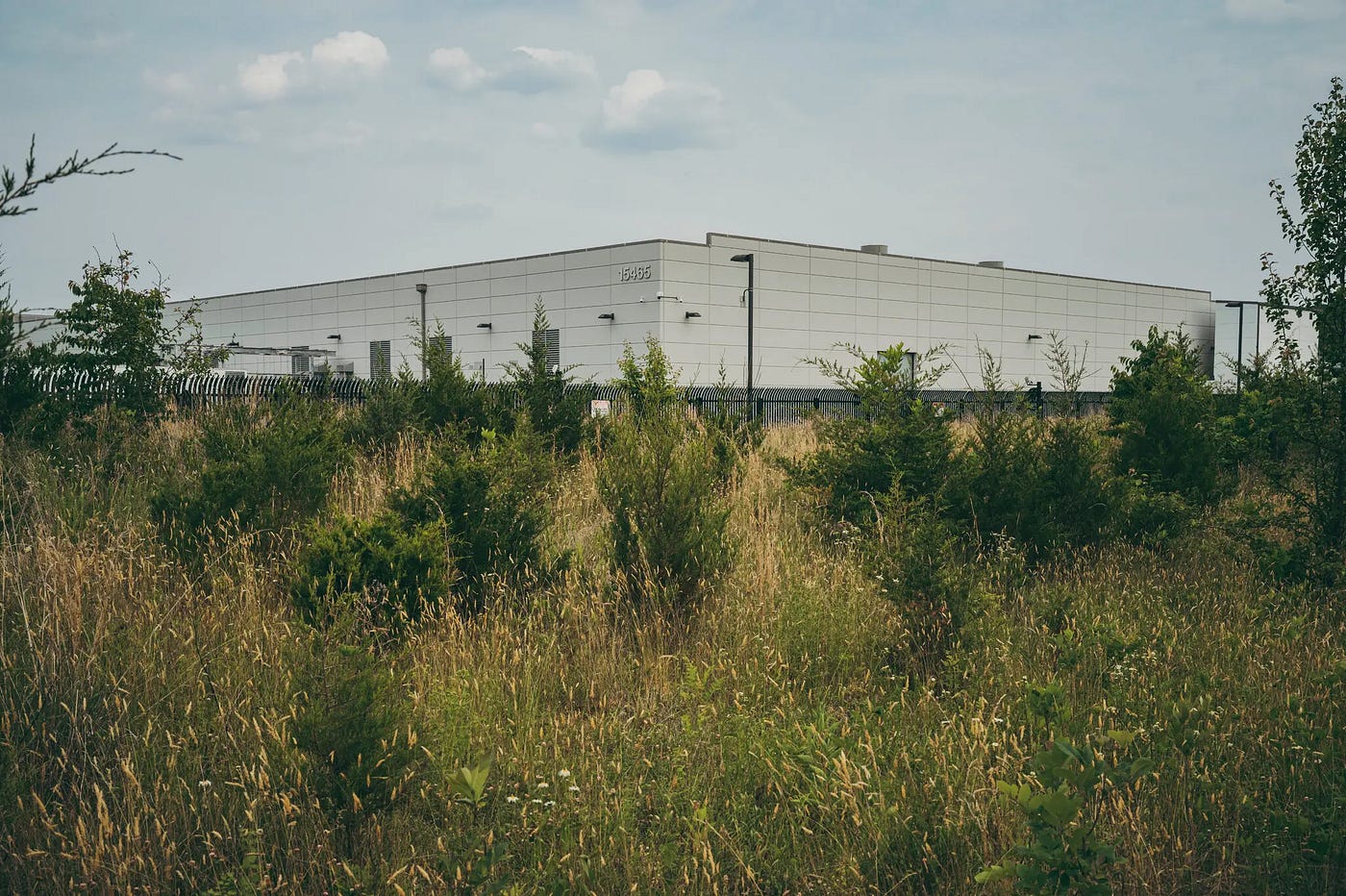
Full facade treatment works. Corgan's CoreSite CH2 in Chicago, Gensler's Microsoft hyperscale facilities in Northern Virginia, Meta's Henrico County campus with its tobacco-barn-referencing panels—these buildings don't generate community opposition the way blank concrete boxes do. But they are exceptions triggered by specific conditions: downtown sites, powerful design review boards, corporate flagship status, or a rezoning fight the developer needs to win badly enough to pay for it.
For the other 90% of projects, the calculus is different. Permitting in established markets already runs 2 to 3 years. Architectural redesign adds to that.
The big squat buildings are hard to upgrade aesthetically; it's always going to be a big flat warehouse-looking building. We also have some clients where their model is not to spend any more money than they have to because it's all going into the infrastructure.
That's Mary Hart, mission-critical practice leader at HKS, putting it plainly.
The proof that something in between works
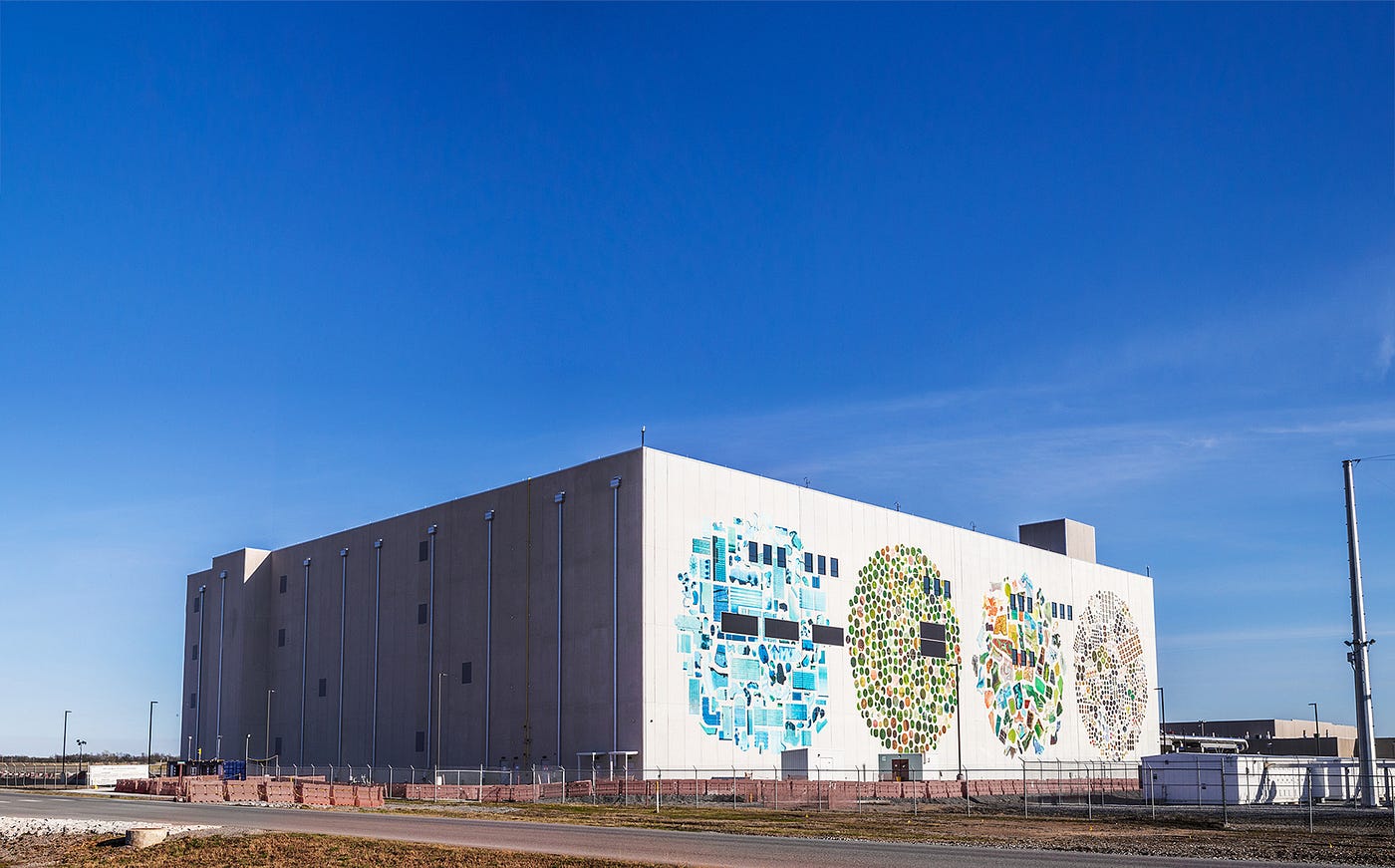
Google commissioned hand-painted murals at data center facilities in Oklahoma, Belgium, Iowa, and Ireland starting in 2016. VP Joe Kava's framing at launch:
Because these buildings typically aren't much to look at, people usually don't, and rarely learn about the incredible structures and people who make so much of modern life possible.
The murals didn't redesign the buildings. They changed what the buildings communicated.
PSE&G's substation mural program in New Jersey is the more instructive case. The Nye Avenue Substation in Irvington carries nine murals "commissioned in response to a request from Irvington officials during the substation's zoning approval process." That's not a goodwill gesture. That's a graphic treatment satisfying a regulatory aesthetic condition, on a utility building, at industrial scale.
What the solution looks like
Large-scale surface patterning applied directly to the building exterior.
No rebuilding, no changes to the building envelope. Painted or vinyl-applied pattern geometry, designed at the scale of the building rather than a signage panel. A structure running 500,000 square feet of exterior wall is a systems problem, and patterning at that scale solves it the same way the building was designed: with precision, repetition, and scale.
A site that needs to recede gets a treatment derived from what surrounds it. Forest, terrain, sky, stone, sampled and translated into geometric form at facade scale. From the road it reads as landscape, not warehouse. A site in a denser or more visible context gets large-scale patterning that signals the building was designed, not just erected. Both satisfy the specific language planners are writing into codes: surface differentiation, visual articulation, fenestration equivalents.
The cost sits closer to a landscape budget than an architectural one. On a $500 million build, it is a rounding error.
We got pushback and the authorities saying, 'You're just greying the whole area with blocks. Can you not make them look a little better?'
That's Lex Coors, Digital Realty's chief data center technology officer, describing the demand without meaning to. The answer is on the wall. Literally.