Google's Data Center Murals: What the Program Proved and Why It Ended
In 2016 Google hand-painted four of its data centers, documented the results, and then stopped. The program proved a treated exterior is achievable, community-effective, and cheap — and showed exactly why a bespoke art commission could never scale to the buildings going up now.
In May 2016, Google announced the Data Center Mural Project. The premise was direct: data centers are not much to look at, and Google wanted to change that for a handful of its facilities. The company commissioned four artists to paint the exteriors of four data centers across two waves.
What Google did
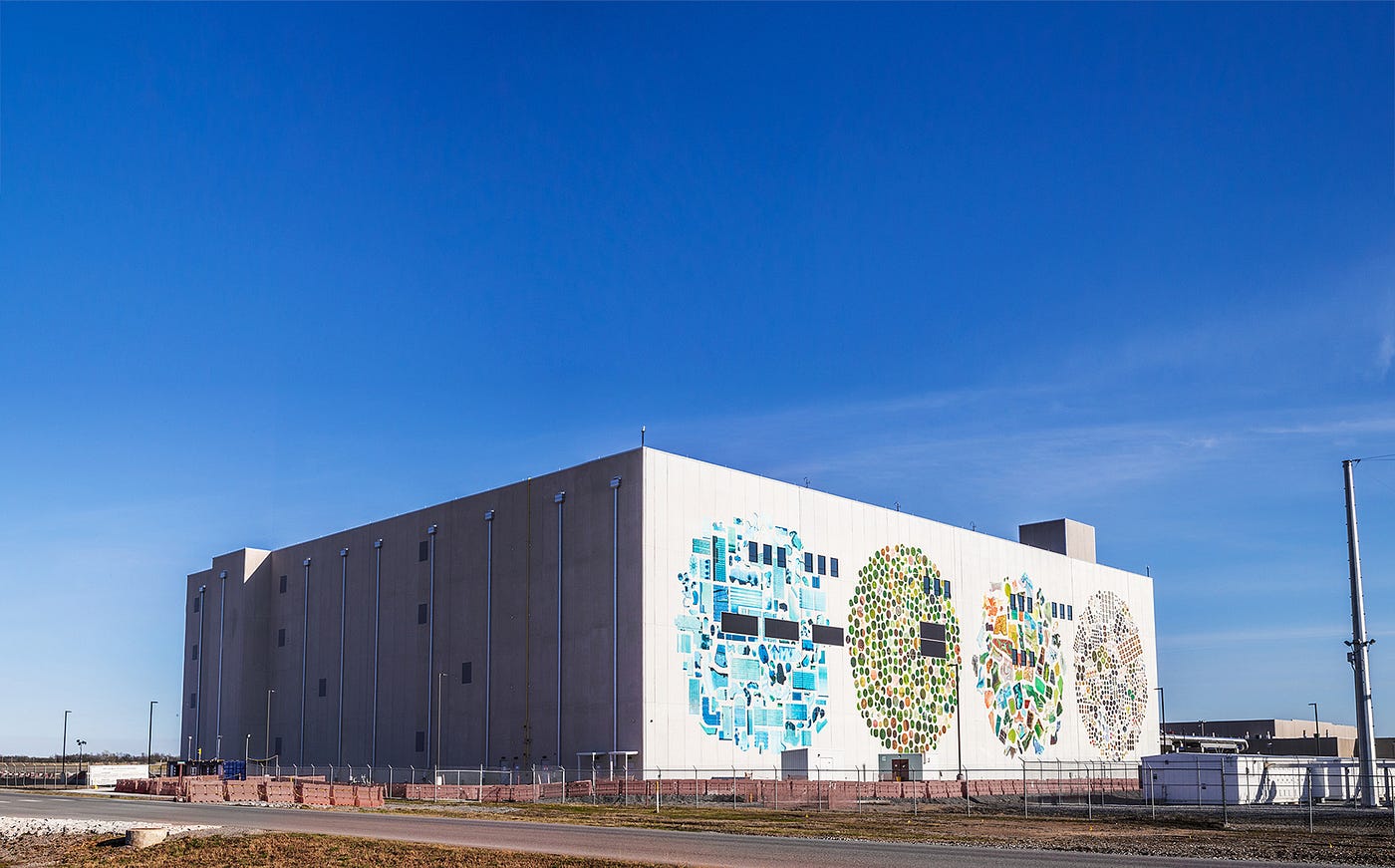
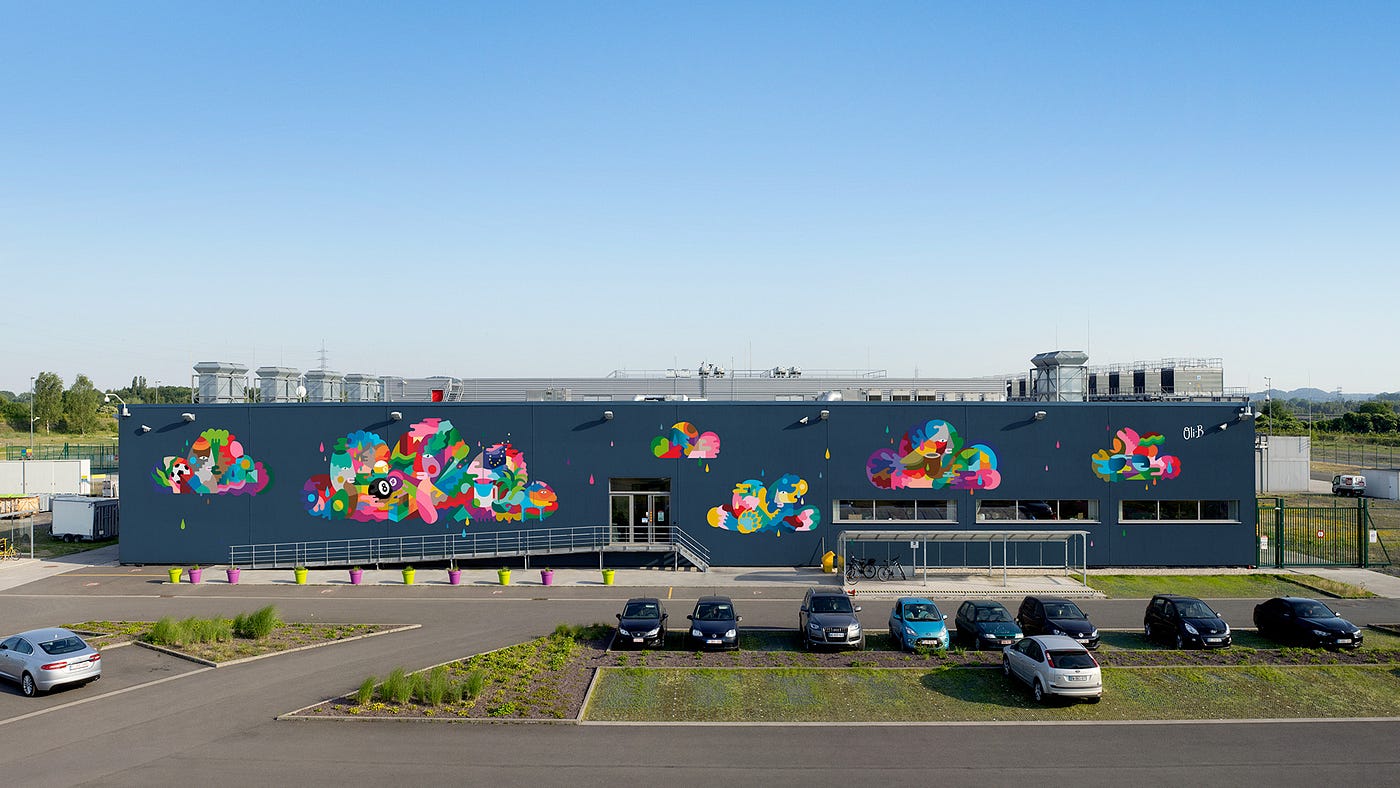
The first two murals launched simultaneously. In Mayes County, Oklahoma, digital artist Jenny Odell built her mural from Google Maps satellite imagery—circular farming features, water treatment infrastructure, and aerial patterns collaged into three large disks on the building's exterior. In St. Ghislain, Belgium, street artist Oli-B painted an abstract interpretation of cloud computing, incorporating local details including the sheep that graze on the data center grounds and imagery from the town's annual festival.
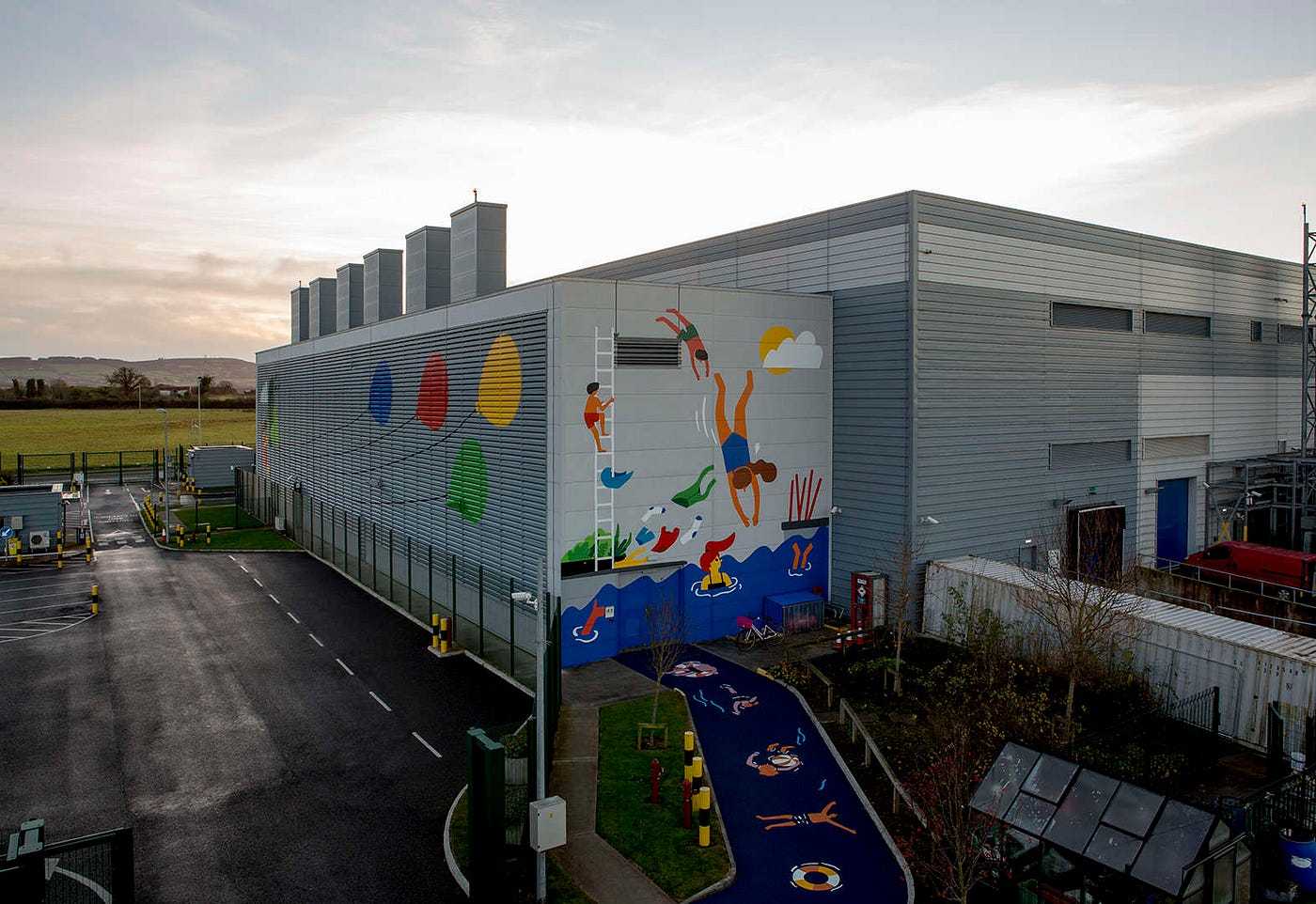
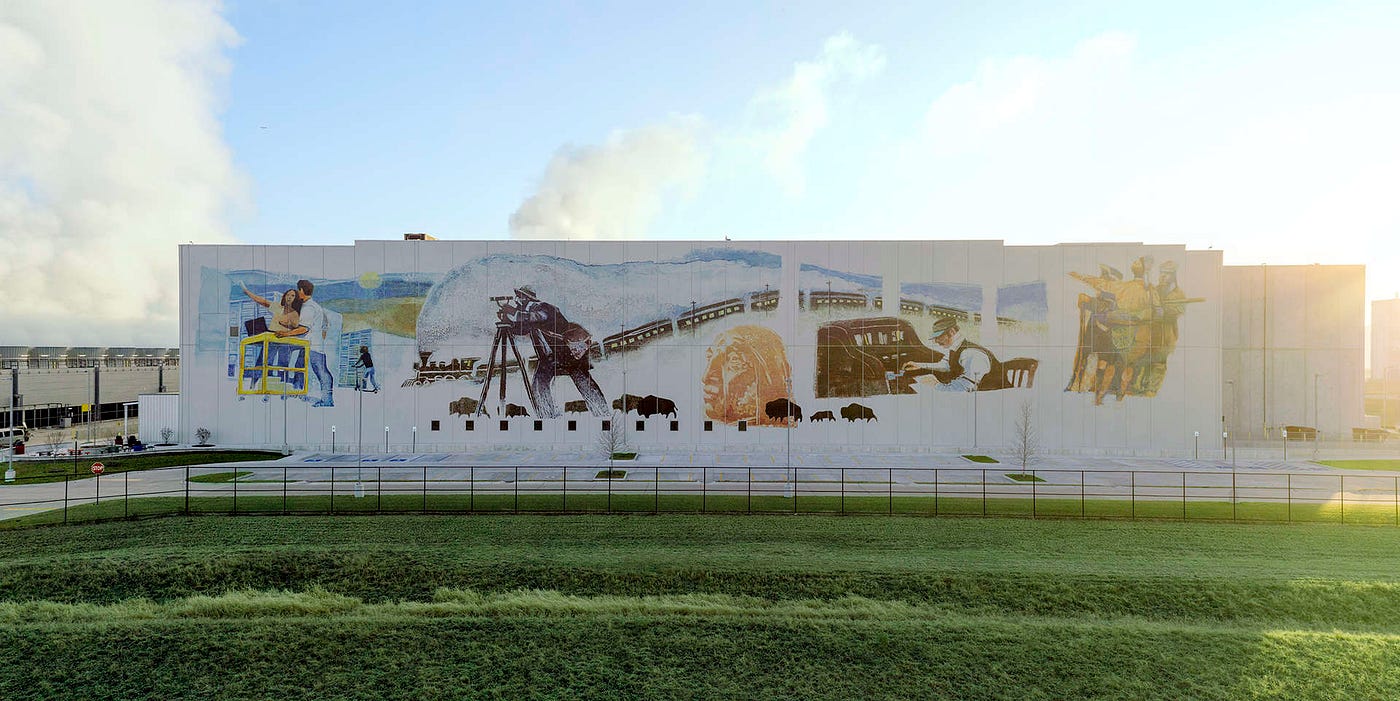
The second wave followed in early 2017. In Council Bluffs, Iowa, illustrator Gary Kelley painted a narrative mural chronicling the region's history as an information hub: Lewis and Clark, the transcontinental telegraph, the railroad, and Googlers working at the facility. In Dublin, Ireland, illustrator Fuchsia MacAree painted a series of scenes from Dublin landmarks across the building's louvered walls—the ones that draw in fresh Irish air to cool the servers inside.
All four murals were hand-painted. All four were documented with photographs, video, and artist interviews on a dedicated project site that Google built and still hosts. By early 2017 the program was complete. There is no documented fifth mural.
Why they did it
Google's stated rationale was community connection. Data centers are large buildings in smaller markets. Mayes County has a population of around 40,000, Council Bluffs around 60,000. They tend to arrive with significant physical presence and little acknowledgment of where they are. The mural project was Google's attempt to change that relationship.
Each artist was briefed to reflect both the function of the building and the community surrounding it. The results were site-specific in a way that generic facade treatments are not. Odell's mural referenced Oklahoma's agricultural infrastructure. Kelley's referenced Iowa's role in American communications history. MacAree's referenced Dublin's geography and climate. The buildings became legible as belonging somewhere specific rather than as interchangeable industrial structures.
There was a secondary effect that Google was less explicit about but that the coverage made visible. A painted data center gets photographed. It gets written about. It generates the kind of local press that a blank wall never produces. Slate and Data Center Knowledge covered the project in 2016 and reached audiences that no data center press release would have touched.
These buildings became legible as belonging somewhere specific rather than as interchangeable industrial structures.
What it proved
The program established several things that had not been demonstrated at that scale before.
Large-scale exterior treatment on an active data center is physically achievable. The logistics of surface preparation, paint systems rated for industrial exteriors, and color consistency across tens of thousands of square feet are not trivial. The mural project showed they are solvable, and Google documented the process well enough that the evidence exists.
Community response to a treated building is different. Google's own documentation noted positive reception in each market. Local officials in Mayes County and Council Bluffs publicly praised the program. The coverage framed the buildings as civic contributions rather than industrial impositions.
The cost is marginal relative to the build. Google's data center investments in each of these markets ran into the hundreds of millions of dollars. Artist fees and installation for a mural project of that scale would have been a small fraction of a percent of total project cost. The program was not a significant financial commitment. It was a small one with outsized visibility.
Why nobody followed
The Data Center Mural Project ended after four buildings and less than a year of active production. No other hyperscaler launched a comparable program. Google itself did not expand it.
The program lived inside Google's communications and brand function, not its facilities or real estate development function. That meant it was evaluated as a PR and marketing initiative. When the internal calculus shifted—and at a company the size of Google program priorities shift constantly—there was no institutional home for it elsewhere. It was not embedded in the development process. It was not a specification that facilities teams could carry forward. It was a campaign that ran and ended.
The artist-dependent structure made it difficult to repeat at scale. Each project required identifying an appropriate artist, negotiating a commission, managing a custom installation, and producing documentation. That process can produce four exceptional results. It cannot produce forty. By 2017 and 2018, hyperscalers were building data centers at a rate that a custom art commission model could never keep pace with.
The broader industry had also settled on a different answer to community opposition: landscaping, community benefit agreements, and government relations. Those tools were already budgeted and already understood. Adding an exterior treatment program would have required justifying a new line item against a mitigation toolkit that was already in place, however imperfectly.
What the gap looks like now
The regulatory environment has changed substantially since the mural project ended. Loudoun County, Prince William County, Fairfax County, and Henrico County in Virginia have all adopted or proposed ordinance language requiring facade treatments, visual articulation, or fenestration on data center buildings. Berlin Charter Township in Michigan is working through similar language. These requirements did not exist in 2016.
Community opposition has also grown. The volume of data center construction has increased, the buildings have gotten larger, and the communities receiving them have gotten more organized. What Google was doing voluntarily in 2016—treating the building's exterior as something worth designing—is now showing up as a compliance requirement in the ordinances of the markets where most data center development is concentrated.
The mural project proved that treating a data center's exterior as a designed surface is physically possible, community-effective, and cost-manageable. The question it did not answer was whether that treatment could be delivered as something other than a bespoke art commission, built around individual artists, managed project by project. That question is still open. The regulatory pressure now exists to make answering it worth the effort.
What a solution would actually require
The Google program defined exterior treatment as a storytelling exercise. A mural draws attention to a building and invites engagement with it. That is a legitimate outcome in the right context. It is not the only one. A coating system applied at scale can do the opposite: break up a building's mass, pull color from the surrounding landscape, and make a 400,000 square foot structure read as less dominant rather than more visible. A treatment developed for a rural site in the Southwest looks different from one developed for a residential-adjacent site in Northern Virginia. Neither looks like a mural.
A commissioned mural requires finding an artist, negotiating a scope, managing a custom installation, and producing documentation—for every building, from scratch. That model produced four results in less than a year and could not scale beyond them. A repeatable program requires a design methodology that can generate site-specific outcomes without rebuilding the process each time: documented surface preparation requirements, coating systems rated for industrial exteriors, color and pattern protocols that can be specified, reviewed, and executed by a contractor rather than an artist.
Timing determines what exterior treatment can accomplish, and the Google program illustrates the ceiling of the wrong timing. Murals applied to buildings already operating in their communities function as goodwill. They cannot shape a planning board record that closed years before the artists arrived. A treatment introduced at the design stage—before a community has formed an image of the building and before a planning board has developed expectations about what it should look like—does something structurally different. It becomes part of the entitlement case rather than a response to it.
For existing buildings the calculus is different but not less relevant. An operating facility that reads as an industrial intrusion is still there every day, and in markets where operators return to planning boards repeatedly for expansions and new phases, initial approval is not the end of the conversation. It is the beginning of one that runs for decades. A retrofit treatment changes what that conversation is built on.
The entitlement environment in 2026 is materially different from what Google was navigating in 2016. Ordinances now specify facade treatments by name. Planning boards in Northern Virginia and other high-density markets have reviewed enough projects to recognize when an applicant is doing the minimum. A landscaping plan and a community benefit check still get submitted. They are no longer sufficient on their own, and in some jurisdictions they never satisfy the facade language at all.